Total Pageviews

Sunday, June 12, 2011

Upper Galilee

I apologize for this blog probably reading like a bad version of Cliff’s Notes on the Middle East, but what’s going on here is a little like trying to get a drink out of a fire hose, so please excuse the attempt to summarize way more than anybody can possibly absorb.

Sunday morning began with a boat ride north on Galilee. We put out here at Tiberias and spent about an hour slowly traveling up the western shore. The Sea of Galilee is, of course, a major centerpiece in Jesus’ ministry. His famous boat trips back and forth say much about his intentions to bring people together and break down walls of race and culture and more. The western shore was predominantly Jewish (mixed with Gentiles), while the eastern Decapolis region was largely pagan. Yet, Jesus loved both sides of the lake, taught on both sides, and did miracles on both sides. The boat (particularly in Mark’s Gospel) is a vehicle for communicating his universal mission. Galilee is about 8 miles at its widest (east-west) and approximately 14 miles long (north-south). Depth is up to 15o feet. A scary, terrifying place to be in a storm. It's a rift in he earth, surrounded by steep hills,  This is where, geologically, Asia and Africa meet, so there is still seismic activity, most light. Major quakes, like one in the 700s A.D., destroyed numerous cities, some never coming back. The last major earthquake here was in the 1920s.

We put ashore at the location of the “Jesus Boat” museum. A number of years ago, a drought revealed a first-century A.D. fishing boat in the reeds nearby. It was excavated and preserved and came to be known as the “Jesus Boat,” perhaps one very much like the ones Jesus was in with his disciples so many times. Now it’s on permanent display. From the museum, we went to the Mt. of Beatitudes, the traditional site where Jesus delivered the Sermon on the Mount. Is it? Who knows? But it made a great spot to have Sunday church. We gathered under a beautiful garden pavilion to pray, sing, and share the Supper. Oh, and I preached a little (yes, from Matthew 5-7).

Next stop, just a little north up the eastern shore to the fishing village of Capernaum (or Kefar Nahum). The sign welcomes you to “The Town of Jesus,” which is about right. Many of Jesus’ disciples came from Capernaum, and he spent considerable time here. It’s a well-excavated site, featuring a house identified with Peter (or at least Peter’s mother-in-law). This is where, perhaps, Jesus healed her of her fever, healed a paralytic lowered through the roof, and others. Anton Farah described it as Jesus’ “free clinic” to the Galilean masses. The synagogue there (where Jesus cast the demon from a man) is pretty cool. The old original dark-stoned building is visible at the base of the 4th-century white-stone one that rises above the surface today. It’s easy to imagine ancient assemblies of people gathered to discuss and pray and read Torah. By the way, the local rock here is almost black, volcanic, so it’s easy to spot the older, original building materials.

We ate lunch nearby right on the lake at a local fish restaurant. I had the “St. Peter’s Fish,” which is tilapia. Very good, though mine did not, unfortunately, prove to have a coin in its mouth, like Peter’s. There used to be more species of fish in Galilee than there are today (25 or so), but tilapia has always been the staple.

We went on to the ancient ruins of Chorazin (or Korazin). There is a ritual bath (mikvah) there. Like Capernaum, Chorazin too had a synagogue. Houston folks, I’m pretty sure that somewhere there exists a photo of Cynthia Michaud seated in the Moses Chair (reserved originally for wise, older males). My comment? “The Bering folks will think that’s just about right.” Along with Bethsaida, Chorazin is one of the cities on which Jesus pronounced woes.

Our journey into Upper Galilee sent us farter north, passing kibbutzes galore, avocados, pecan trees, cotton fields, and all kinds of lush, verdant scenery. This is the land of Naphtali, and our guide, Anton Farah, was born up here in this area, at Sieff. Soon we were near the Lebanon and Syria borders. In the city of Qiryat Shamona, we began seeing a lot more Israeli soldiers carrying automatic weapons. Things are a little tense up here with the rising unrest in Syria.

With Mt. Hermon now rising in the distance, towering above the landscape at more than 8,000 ft., we began going upward. No snow on Hermon right now (though it does have ski resorts), but its ice caves are still mostly frozen, melting and sending water southward down the Jordan to Galilee. This is the ancient cycle of this land. The cold, snowy Golan Heights water the dry south, season after season.

Anton explained that Hezbollah (in Lebanon) periodically fires its rockets into Qiryat Shamona and these northern villages. We looked across into Lebanon, where we could see an old bunker that was given years ago to Yassir Arafat, when he was still in power. We began spotting signs that indicated “Danger: Lands Mines.” At both our next two stops we could hear distant gunfire, either from Lebanon or Syria. Our guide simply said, “It happens here.”

We crossed into Syria to visit Caesarea Philippi (also known as Banias). Built by Philip, son of Herod the Great, this city was dedicated to Caesar Augustus, who had a temple here. The chief god was Pan, who was worshiped with loud music, drunkenness, and sexual acts with cult prostitutes. The excavations here on the mountainside (much by Church of Christ scholars like John Wilson) have uncovered amazing finds, and the cave of Pan and the shrine of the Nymphs on the cliff side are stunning. The place is both beautiful with its trees and rushing water (melting snow) and ugly with its story of pagan sin. This is where Jesus took his disciples and asked them, “Who do they say I am?” (Matthew 16). Peter famously confessed, “You are the Christ, the Son of God.” Then Jesus affirmed Peter’s confession and said—perhaps with Pan’s goat-sacrifice grotto looming in the background—“And the gates of hades will not prevail against it.” With the craggy face of the mountain behind him, he told Peter that “upon this rock I will build my church.” The symbolism and contrast must have been powerful.

Our last stop was equally memorable—Tel Dan. This is the northernmost site in Israel. Remember the Old Testament refrain “from Dan to Beersheba”? At Dan, you get a gorgeous nature walk through essentially a forest (or jungle) of thick trees and flowering plants. We saw hundreds of school children in groups here. We crossed the rapid headwaters of the Jordan (which means “coming from Dan”), then Anton gave us a detailed walk through the excavated ruins of the old city of Dan, which was once something remarkable. This is where the tribe of Dan relocated after initial settlement in the west. Their great wall still partially stands (with a few Hezbollah bullet holes). We saw the place where judges stood to judge (see the story of Ruth) at the city gates. We saw Dan’s knock-off of the Jerusalem temple, with two altars, and remembered the two golden calves, one which was brought to Dan by Jeroboam. We saw an amazing city gate (originally three arches) that probably dates back to Abraham and welcomed him to Canaan two millennia ago.

It was a long hard day, with a lot of walking, so some of us napped on the bus ride back to the hotel. We cleaned up and ate dinner, then some of us strolled around the shops of Tiberias this evening. Finally, Melinda and I joined Steve and Lynette Austin (their group is in the hotel with us the next two nights) for a late evening ice cream cone by the Sea of Galilee. It was a very nice visit with one of my new UCC elders and his fantastic wife. Too bad we have to come 6,000 miles to find time to get together for conversation! Oh well.

Hope you are all getting along fine, especially our two sweethearts, Jordan and Sarah. Hope you had fun at the movie yesterday with the cousins and Gram and Pappaw. We loved talking to you last night on the phone. Jordan, the parents of your friend Abby who goes to taekwando with you are with us on this trip! We will get together sometime when we are all back home.

Long day. Another early start tomorrow. Itinerary: Cana, Nazareth, and Mt. Tabor.

Oh, and go Dallas Mavericks!! Postscript... I just saw they did it, 105-95, to win their first NBA Championship. Sweet!

Shalom,
Brent and Melinda


Saturday, June 11, 2011

Photos (Day 2)

This first one is for Jordan and Sarah... "Kung Fu Panda 2" for kids who speak Hebrew.

Caesarea... Behind us people are fishing among the ruins of Herod the Great's palace.

Caesarea's great theater (complete with vomitoriums for the most drunken spectators :-)

Looking up out of King Ahab's water tunnel at Megiddo.

The Jordan River, just south of the Sea of Galilee.

Finally, the view out our hotel balcony this evening, looking southward over Galilee.

The Road to Galilee

Day two was full. We hit the road at 8:00, immediately after breakfast

It really would have been nice to see more of Tel Aviv, which is a beautiful city and, actually, Israel's largest. Jerusalem's total population is a little more, but Tel Aviv takes up more real estate and has the lion's share of the wealthy, highly-educated Israelis. Tel Aviv was the heart of the Zionist movement and the birth of Israel in 1948. We saw sites where Saddam Hussein hit with scud missiles during the 1991 Persian Gulf War. But alas, we had to move on... We wound out the main road northward through high-end neighborhoods and the burgeoning tech center of Israel. It's not hard to see the truth that about 70% of Israel's 7.5 million citizens live in urban areas. 

We followed the coastline north through Netanya (once a center for gold and diamonds); through Alexander (named for Janus the Hasmonean ruler); and into Caesarea Maritima."Maritima" means "near the sea." Named for Augustus Caesar, built by Herod the Great, Caesarea is, even in ruins, a wonder to behold. Three years before Herod, the Phoenicians had a port here, but the crazy-but-brilliant Idumean Herod transformed something modest into the centerpiece of Roman naval and commercial traffic. We watched a short video about the long history of Caesarea--from Herod and the Romans, to Byzantine rule, Arabs, Crusaders, Ottomans, British, to the present. Then we walked the grounds, listening closely to Anton Farah's amazing commentary. The amphitheater is still there. So are the ruins of the hippodrome, where chariots raced. Herod's palace is obvious, leaving behind his swimming pool, fed by an awesome freshwater aqueduct system--Herod started it and Roman emperor Hadrian later expanded it. The Romans were unbelievable builders. And others who came later left their mark as well, witness the ruins of Crusader fortress facilities. One of the most striking things we saw was the ruins of a pagan temple, a Christian church, and a Muslim mosque all on the same site here. Time just passed it on from one set of worshiper hands to the next, each adapting to their own needs.


This happens to be holiday here in Israel--the feast of Shavuot or feast of Weeks. Most of us know it better by its Greek name, Pentecost. This holiday, which celebrates the giving of the Law, comes fifty days after Passover, closes schools and businesses, and prompts many Jews to celebrate in various ways. We have seen a lot of people spending family time outdoors--sightseeing, playing, picnicking, you name it--as we have traveled. 


After Caesarea, we continued north to Mt. Carmel. On the way, we passed old Crusader camps, miles and miles of fertile countryside--sunflowers, bananas, almond trees, and more. Haifa is a striking city with a population of 300,000 that welcomes you eventually to the climb up Carmel. At the top, the Carmelite monastery marks the spot where Scripture says Elijah squared off against the prophets of Baal, eventually destroying them following victory in their battle of the gods. On the top of the monastery, we got a tremendous view eastward toward the Jezreel Valley and upcoming destinations--Megiddo, Gilboa, Nazareth, and more. Anton gave us a play by play of everything we could see from this magnificent vista.


We had lunch in the mountains (some call this area Israel's mini-Switzerland) at a Druze restaurant. The Druze are an odd and secretive religious order directed by Muslim sheikhs. They claim to follow Jethro, Moses' father in law, but few really know what they believe. One thing they are known for is food, and we stopped for an hour to eat falaffel and schnitzel and more. Here, we crossed paths with Steve and Lynette Austin (from Abilene and UCC) and their concurrent tour group. We will see them again tomorrow and look forward to that. 


We continued on through rural areas that reminded me of the Texas Hill Country--rocky, oak trees, steep hills, winding roads, and cacti. Exiting the higher mountains, we came down to the plain of Jezreel, driving by kibbutzim and old Roman cemeteries (including a family tomb with a rolling stone entrance in front). Our next stop was Tel Megiddo. From 3:00-4:00pm we took a walking tour of the park there, which is memorable, to say the least! Anton explained that this site has always been the topography, a significant, strategic place where roads between Asia and Africa and key mountain passes (valleys) intersect. A political and military hotspot for centuries and centuries. This real estate changed hands twenty-five times, being built and destroyed over and over. Megiddo is presumed to be the "Har-Mageddon" or "Armageddon" referenced in Revelation 16. Christians have long associated this place with a final cataclysmic end times battle between good and evil. Maybe. Maybe not. But it was a big deal in Solomon's day, for sure. Perhaps he brought Sheba here to impress her? His palace and stables are still here, having been excavated by many teams over many years. Jeroboam's granary is incredible. We went down into King Ahab's famous water tunnel, a genius feat of engineering (and slave labor, no doubt) to get water into Megiddo. It was a long walk down and out, but well worth it. 


Leaving Megiddo, we hit the road east to Tiberias, through Afula and by Mt. Moreh (see the story of Gideon and the Midianites). We passed Nain, where Jesus raised a widow's dead son. We passed Mt. Tabor and the region of Deborah and Barak and Sisera and Jael. We saw Nazareth in the hills to our north (we will spend time there soon). Now in Lower East Galilee, we passed a sign to En Dor (remember Saul's witchy friend?). We sped by the Horns of Hattin, where on July 4, 1187, the Muslim commander Saladin finished off the Crusader army once and for all. 


Then, like an old friend we had never met, it appeared on our left--the Sea of Galilee. Like a bowl of water, surrounded by hills and mountains, there she was. Soon we were in Tiberias, on her southwest shore (250 meters below sea level, by the way). We couldn't check into our hotel until 6:00 due to Sabbath, so we took a quick trip south to the location where the Jordan River exits Galilee. This is one of the traditional sites associated with Jesus' baptism, and many come here to be baptized. We watched several being immersed. It's a peaceful place, surrounded by big trees (and a very commercial gift shop). After an hour here, we came back into Tiberias and checked into our hotel--the Caesar--had dinner and retired for the evening, pooped. We will be here three nights.


Tomorrow: Morning worship, then north to Capernaum, Tabgha, Caesarea Philippi, and the Golan Heights.


Shalom Y'all,
Brent and Melinda

Friday, June 10, 2011

Photos (Day 1)

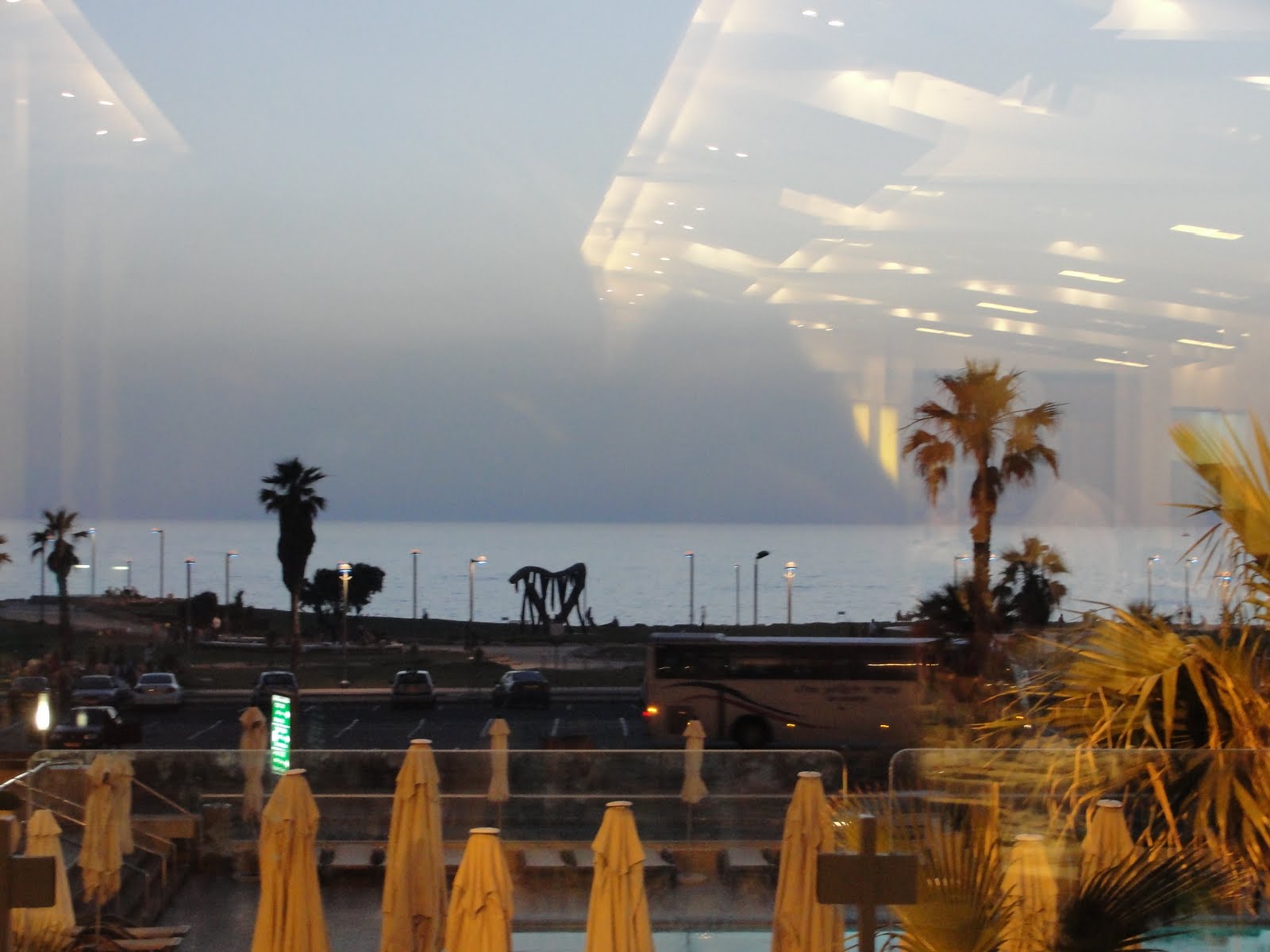
The Mediterranean just before sunset, arriving at the hotel...

Getting a feel for the water (it was a little chilly but felt okay)...
 
Good night from Tel Aviv...

Tel Aviv

We are here. After weather and mechanical delays getting from DFW to Newark, and about two additional hours of sitting on the tarmac there waiting to take off, we finally got in the air a little after midnight Friday. At Newark, we picked up the majority of the rest of our group of 36--people from Houston, California, New Hampshire, and other places. Two folks from Chicago had their flight cancelled and had to reschedule. We met one traveler from South America here in Tel Aviv. The flight time is about ten hours, so we got into Tel Aviv about 5:00pm local time (Israel is eight hours later than Texas).

We were met at the airport (named for Israel's original prime minister David Ben Gurion) by our guide, Anton Farah. Anton is a Christian from Nazareth, and he is a walking encyclopedia of the Middle East. Gary McCaleb introduced Anton to us, and he was off and running with the commentary and stories! We travel on a large bus, and as we pulled out of the airport, Anton began with these simple words: "Welcome home..." Then, he began filling us in on the following...

The airport is located in the Sharon region (as in, "rose of Sharon"). In Old Testament times, the Mediterranean coast belonged to the sea-faring Phoenicians (north) and the Philistines and their city-states: Gath, Ashdod, Ashkelon, etc. (south). The area around modern Tel Aviv was where many stories about the judges took place (Samson particularly). These coastal plains were known in ancient times for being swampy and malaria-ridden. Dan was given this area as a tribe, but despised what they were allotted--bad neighbors, disease, marshes and more made it less than desirable. This was really the case all the way into the 19th century, when European Jews came back to settle and mastered the industry of agriculture and turned once useless land into oasis, complete with fruit trees (oranges, grapefruits, etc.). Anton explained how, in a sense, the "rose" of this region finally bloomed.

As we moved into Tel Aviv proper, Anton pointed out that to the south was the "mother"--old Joppa. Just north is her "child"--Tel Aviv. Tel Aviv was not actually begun as a city until the early 1900s, but she was born out of the ancient port of Joppa. Joppa--the port where the cedars of Lebanon were brought into Israel for building the temple of Solomon. Joppa--as in the place where Jonah set sail for Tarshish to avoid preaching to Gentiles. Joppa--the place where Peter got a rooftop vision about not calling things unclean that God called clean, then was sent to Cornelius. (Joppa seems to attract reluctant preachers, it would seem).

After checking in at the beautiful Dan Panorama Hotel, our group freshened up, unpacked, and went to dinner together at 8:00. This is Sabbath, so we were eating a hotel buffet with local observant Jewish families, dressed up, saying their Shabbat prayers and eating kosher delicacies. I told someone it seemed like the equivalent of Sunday post-church lunch at the local cafeteria. Following dinner, a group of us walked down to the Mediterranean (our hotel is right on the water) and strolled the beach, walking out into the water under a half moon. It's humid (think Houston), but the night air was very nice, and the night view was gorgeous. Along the waterway, local families and young people (many Arabs) played in the parks and cooked out, not unlike American families do this time of year.  

Tomorrow we begin in earnest. We get up at 6:00 to pack up and have our bags outside the door for pick-up at 7:00. Breakfast is 7:00-8:00, then we head to Caesarea, Megiddo, and into the northern region, including Haifa and Mt. Carmel. Then on to Tiberias located on the Sea of Galilee, where we will be spending three nights at the Caesar Hotel. This is a great group of people, and we are all enjoying getting to spend time with each other and learning to love new people as we explore this amazing place.

Jordan and Sarah, mom and I love and miss you girls!!! What are you doing? Hope you are having a lot of fun with Gram and Pappaw. We will be telling you a lot more about what we see in days to come. 

Feel free to send questions, requests, comments, etc. We welcome your participation with us in this little Holy Land sojourn.

Shabbat Shalom Y'all,
Brent and Melinda
 

Wednesday, June 8, 2011

15 Hours and Counting

We are now down to hours instead of days before our departure.  The girls have been handed over to the grandparents so now we are focused on the final tasks before we leave.  Well. . .I'm focused on the final tasks.  Brent has gone to bed.

As is typical with an Isbell family trip, Brent left the packing to me. It seemed too easy getting everything into our suitcases.  There was too much room.  We had to be forgetting something.  At that point I realized I wasn't having to save room for 21 days worth of diapers for a new baby.  I felt like I had won the packing lottery!!

So, all of our bags are packed with the exception of the last little things that we need tomorrow morning.  All of our electronic gadgets are plugged in and charging.  The house is clean and the bills are paid.  Now all that is left is finishing laundry, wrapping up few things for work and running a couple of short errands tomorrow morning.  Then we will be on our way.

Monday, June 6, 2011

Four Days Out

In four days, we will be in Israel. I'm not sure what is more challenging, coming home from extended travel or getting ready to go, but right now it seems like the getting ready is the challenge. Lots of things to do to prepare for being away from home and church for nearly two weeks. Not to mention being away from our two girls. Maybe I will use this space to address some common questions we're receiving...
  • The girls? Jordan and Sarah will be staying with my parents, who lived in Bastrop, TX. We will meet Wednesday to drop them off.
  • Packing? Believe me, I'm leaving that mostly in the hands of Melinda, who is truly one of the world's great packing pros. We are trying to pack as lightly as possible, due to restrictions on the amount of luggage. This reminds us a lot of our China trips, and the truth is that most people pack way too much, even when you're trying not to.
  • Travel group? It's a very mixed group of 35. Some will know each other, many won't. Some are Houston friends. Some are from Abilene. Others are from California, New Hampshire, and everywhere in between. Dr. Gary McCaleb is our leader and veteran Israel traveler, having led multiple trips. Dr. Phil Schubert, ACU president, will be traveling with us, along with one of his daughters.
  • Weather? We are expecting highs in the 80s and lows in 60s in Israel, which is a little more moderate than Texas right now. Sunscreen, hats, and sunglasses are a must though. We will have the opportunity to get in the water at the Mediterranean, the Sea of Galilee, and the Dead Sea.
  • Clothing? Cool and casual, for the most part. There are a few places that females need head coverings or something on bare shoulders or legs, but for the most part it's very Western.
Okay, that's enough for now. More later as we are nearing departure.

Shalom,
Brent and Melinda